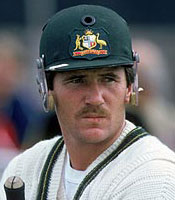
Allan Robert Border, AO (born 27 July 1955) is a former Australian cricket captain. His playing nickname was "A.B.". He played 156 Test matches in his career, a record until it was passed by fellow Australian Steve Waugh. Border still retains the world record for the number of consecutive Test appearances of 153 and the number of Tests as captain. He was primarily a left hand batsman but also achieved sporadic success as a part time left arm orthodox spinner. Border amassed 11,174 Test runs (a world record until it was passed by Brian Lara in 2005). He hit 27 centuries in his Test career. He retired as Australia's most capped player and leading run-scorer in both Tests and ODIs. His Australian record for Test Match runs stood for 15 years before Ricky Ponting overtook him during the Third Ashes Test against England in July 200Border was one of the 55 inaugural inductees of the ICC Cricket Hall of Fame.[2]
Early years
Born in Cremorne, a North Shore suburb of Sydney, New South Wales, Border grew up with three brothers in the nearby suburb of Mosman. His father John, from Coonamble in rural New South Wales, was a wool classer and his mother Sheila was the proprietor of a corner store. The family had a spacious backyard for playing games, and Mosman Oval, the home of district cricket and baseball clubs, was across the street. Border attended North Sydney Boys High School, and earned his leaving certificate in 1972.
Throughout his early years, Border played in cricket teams two or three years older than his age group. He also played for Mosman Baseball Club, where he developed his fielding and horizontal-bat shots. Aged sixteen, he made his début for Mosman in Sydney Grade Cricket as a left arm orthodox spinner and batted at number nine. He won selection for the 1972-73 Combined High Schools team in the intrastate carnival. During this time, he was coached by Barry Knight, a former England international.
Cricket career
Border accumulated more than 600 runs in grade cricket in 1975–76, and at the start of the following season, he made two consecutive centuries to earn selection for NSW.[8] In the absence of a number of Test players, Border made his debut against Queensland at the SCG in January 1977.[9] He compiled 36 and took the last three catches of the match, as his team claimed victory. Border resigned his job as a clerk in the film library of BHP to spend the 1977 English season playing for Downend in the Gloucestershire League. The highlight of his stay was 159 not out in an invitational match against Cambridge University. In Australia, Border compiled 617 runs at 36.29 average during the 1977–78 Sheffield Shield season. He then returned to England and played for East Lancashire Cricket Club in the Lancashire League, scoring 1191 runs at 56.71 and taking 54 wickets at 18.60.[5][11]
Test debut during WSC
In 1977, the breakaway professional competition World Series Cricket (WSC) signed many players who were then banned from first-class and Test cricket, thus leaving many vacancies in the Australian team. Border started the 1978–79 season with his maiden first-class century, 135 against Western Australia at Perth, and followed up with 114 against Victoria at the SCG. After Australia lost the first two Tests in the Ashes series, Border was selected for his Test debut at the MCG. Making a nervous start, he took more than half an hour to score three runs. He made 29 and was run out for a duck in the second innings while attempting a single. In the following Test at Sydney, he was in a "lonely class of his own" by top-scoring in both innings with 60 not out and 45 not out as Australia lost the match and the Ashes. He used his feet to the spinners as his teammates struggled to cope with the turn. However, after scores of 11 and 1 in the Fifth Test at Adelaide he was dropped for the Sixth Test.
Recalled for the First Test against Pakistan at the MCG, Border batted at No. 3 and hit his maiden Test century as Australia reached 3/305, chasing 382 for victory. Border's dismissal for 105 triggered a major collapse of seven wickets for five runs as the other batsmen were unable to cope with the swing of Sarfraz Nawaz. Australia lost by 71 runs. Border made 85 and 66 not out as Australia squared the series with a victory in Perth. In his second Test series, he had topped the batting aggregates and averages with 276 runs at 92.00.
Post-WSC place
In May 1979, the ACB announced an agreement with WSC, which allowed the WSC players to return to international cricket at the start of the 1979-80 Australian season. In the meantime, Australia made two tours, giving the incumbent players an opportunity to press for places in a reunited team. The first tour, to England for the 1979 Cricket World Cup, ended with Australia being eliminated in the first round. Border scored 59 runs in two innings.
This was followed by a three-month-long, six-Test tour of India, on which Australia failed to win a single match. Border scored 521 runs at 43.42 in the Test series, including 162 in the First Test at Madras, where he displayed excellent footwork and handled the Indian spinners much more effectively than his team-mates. As a result of this performance, he was one of only three players to retain their places for the next Test against England at Perth in November 1979 after the WSC players returned. Border scored 115 in the second innings to secure victory and in doing so passed 1,000 Test runs. He had done so in only 354 days, the fastest ever by an Australian, and made more runs (1,070) in his first year as a Test cricketer than anyone before. He was unable to maintain this form, however, and ended the season with 317 runs at 31.70 in six Tests against England and the West Indies.
On the tour of Pakistan that followed, Border hit 150 not out and 153 in the Third Test at Lahore against spinners of the calibre of Iqbal Qasim and Tauseef Ahmed to become the first batsmen in Test history to pass 150 in both innings of a Test. In the off-season, Border married Jane Hiscox, and moved to Brisbane to begin playing for Queensland.[5][24] During the 1980-81 season, he scored 328 runs at 36.44 in six Tests against New Zealand and India, a modest return boosted by a score of 124 against the latter at Melbourne in the final Test of the summer.
Stubborn resistance
In 1981, Border made his first Ashes tour and scored a half-century in each of the first two Tests. "Border alone of the established players came through with reputation enhanced"; in the Fifth Test at Old Trafford when he batted with a fractured left finger. He reached a century in 377 minutes, the slowest Test hundred by an Australian, and remained unbeaten on 123 as Australia lost the match. In the final Test at The Oval, Border scored 106 not out and 84. During this latter sequence, he defied the English bowlers for more than 15 hours to score 313 runs before he was dismissed. Overall, he totalled 533 (at 59.22); this prompted Sir Leonard Hutton to call him the best left-handed batsman in the world and resulted in his selection as one of the Wisden Cricketers of the Year in 1982.
Border's 1981–82 season was mixed. Against Pakistan, he made only 84 runs in three Tests, but against the West Indies, he scored a century and three half-centuries in 336 runs (at 67.20) to help Australia draw the series. On the tour of New Zealand, his three Tests brought only 44 runs at 14.67. After having the winter off, Border returned to Pakistan but was unable to repeat his performances of two years earlier. He scored 118 runs at 23.60 as Pakistan won all three Tests.
After failing in the first three Tests of the 1982–83 Ashes series, Border's place in the Australian team was in jeopardy[citation needed] as Australia led the series 2–0. Border's effort in Australia's loss in the Fourth Test at the MCG is one of his best remembered Test innings. Australia had lost nine wickets and required 74 runs to win when Jeff Thomson joined Border at the crease. 18,000 spectators attended the final day's play as the pair slowly accumulated runs, before a juggling catch dismissed Thomson three runs short of the target. Border then scored pair of 80s in the Fifth Test to secure a drawn match and Australia regained the Ashes. His figures were 317 runs at 45.28 average.
Early years
Born in Cremorne, a North Shore suburb of Sydney, New South Wales, Border grew up with three brothers in the nearby suburb of Mosman. His father John, from Coonamble in rural New South Wales, was a wool classer and his mother Sheila was the proprietor of a corner store. The family had a spacious backyard for playing games, and Mosman Oval, the home of district cricket and baseball clubs, was across the street. Border attended North Sydney Boys High School, and earned his leaving certificate in 1972.
Throughout his early years, Border played in cricket teams two or three years older than his age group. He also played for Mosman Baseball Club, where he developed his fielding and horizontal-bat shots. Aged sixteen, he made his début for Mosman in Sydney Grade Cricket as a left arm orthodox spinner and batted at number nine. He won selection for the 1972-73 Combined High Schools team in the intrastate carnival. During this time, he was coached by Barry Knight, a former England international.
Cricket career
Border accumulated more than 600 runs in grade cricket in 1975–76, and at the start of the following season, he made two consecutive centuries to earn selection for NSW.[8] In the absence of a number of Test players, Border made his debut against Queensland at the SCG in January 1977.[9] He compiled 36 and took the last three catches of the match, as his team claimed victory. Border resigned his job as a clerk in the film library of BHP to spend the 1977 English season playing for Downend in the Gloucestershire League. The highlight of his stay was 159 not out in an invitational match against Cambridge University. In Australia, Border compiled 617 runs at 36.29 average during the 1977–78 Sheffield Shield season. He then returned to England and played for East Lancashire Cricket Club in the Lancashire League, scoring 1191 runs at 56.71 and taking 54 wickets at 18.60.[5][11]
Test debut during WSC
In 1977, the breakaway professional competition World Series Cricket (WSC) signed many players who were then banned from first-class and Test cricket, thus leaving many vacancies in the Australian team. Border started the 1978–79 season with his maiden first-class century, 135 against Western Australia at Perth, and followed up with 114 against Victoria at the SCG. After Australia lost the first two Tests in the Ashes series, Border was selected for his Test debut at the MCG. Making a nervous start, he took more than half an hour to score three runs. He made 29 and was run out for a duck in the second innings while attempting a single. In the following Test at Sydney, he was in a "lonely class of his own" by top-scoring in both innings with 60 not out and 45 not out as Australia lost the match and the Ashes. He used his feet to the spinners as his teammates struggled to cope with the turn. However, after scores of 11 and 1 in the Fifth Test at Adelaide he was dropped for the Sixth Test.
Recalled for the First Test against Pakistan at the MCG, Border batted at No. 3 and hit his maiden Test century as Australia reached 3/305, chasing 382 for victory. Border's dismissal for 105 triggered a major collapse of seven wickets for five runs as the other batsmen were unable to cope with the swing of Sarfraz Nawaz. Australia lost by 71 runs. Border made 85 and 66 not out as Australia squared the series with a victory in Perth. In his second Test series, he had topped the batting aggregates and averages with 276 runs at 92.00.
Post-WSC place
In May 1979, the ACB announced an agreement with WSC, which allowed the WSC players to return to international cricket at the start of the 1979-80 Australian season. In the meantime, Australia made two tours, giving the incumbent players an opportunity to press for places in a reunited team. The first tour, to England for the 1979 Cricket World Cup, ended with Australia being eliminated in the first round. Border scored 59 runs in two innings.
This was followed by a three-month-long, six-Test tour of India, on which Australia failed to win a single match. Border scored 521 runs at 43.42 in the Test series, including 162 in the First Test at Madras, where he displayed excellent footwork and handled the Indian spinners much more effectively than his team-mates. As a result of this performance, he was one of only three players to retain their places for the next Test against England at Perth in November 1979 after the WSC players returned. Border scored 115 in the second innings to secure victory and in doing so passed 1,000 Test runs. He had done so in only 354 days, the fastest ever by an Australian, and made more runs (1,070) in his first year as a Test cricketer than anyone before. He was unable to maintain this form, however, and ended the season with 317 runs at 31.70 in six Tests against England and the West Indies.
On the tour of Pakistan that followed, Border hit 150 not out and 153 in the Third Test at Lahore against spinners of the calibre of Iqbal Qasim and Tauseef Ahmed to become the first batsmen in Test history to pass 150 in both innings of a Test. In the off-season, Border married Jane Hiscox, and moved to Brisbane to begin playing for Queensland.[5][24] During the 1980-81 season, he scored 328 runs at 36.44 in six Tests against New Zealand and India, a modest return boosted by a score of 124 against the latter at Melbourne in the final Test of the summer.
Stubborn resistance
In 1981, Border made his first Ashes tour and scored a half-century in each of the first two Tests. "Border alone of the established players came through with reputation enhanced"; in the Fifth Test at Old Trafford when he batted with a fractured left finger. He reached a century in 377 minutes, the slowest Test hundred by an Australian, and remained unbeaten on 123 as Australia lost the match. In the final Test at The Oval, Border scored 106 not out and 84. During this latter sequence, he defied the English bowlers for more than 15 hours to score 313 runs before he was dismissed. Overall, he totalled 533 (at 59.22); this prompted Sir Leonard Hutton to call him the best left-handed batsman in the world and resulted in his selection as one of the Wisden Cricketers of the Year in 1982.
Border's 1981–82 season was mixed. Against Pakistan, he made only 84 runs in three Tests, but against the West Indies, he scored a century and three half-centuries in 336 runs (at 67.20) to help Australia draw the series. On the tour of New Zealand, his three Tests brought only 44 runs at 14.67. After having the winter off, Border returned to Pakistan but was unable to repeat his performances of two years earlier. He scored 118 runs at 23.60 as Pakistan won all three Tests.
After failing in the first three Tests of the 1982–83 Ashes series, Border's place in the Australian team was in jeopardy[citation needed] as Australia led the series 2–0. Border's effort in Australia's loss in the Fourth Test at the MCG is one of his best remembered Test innings. Australia had lost nine wickets and required 74 runs to win when Jeff Thomson joined Border at the crease. 18,000 spectators attended the final day's play as the pair slowly accumulated runs, before a juggling catch dismissed Thomson three runs short of the target. Border then scored pair of 80s in the Fifth Test to secure a drawn match and Australia regained the Ashes. His figures were 317 runs at 45.28 average.


